
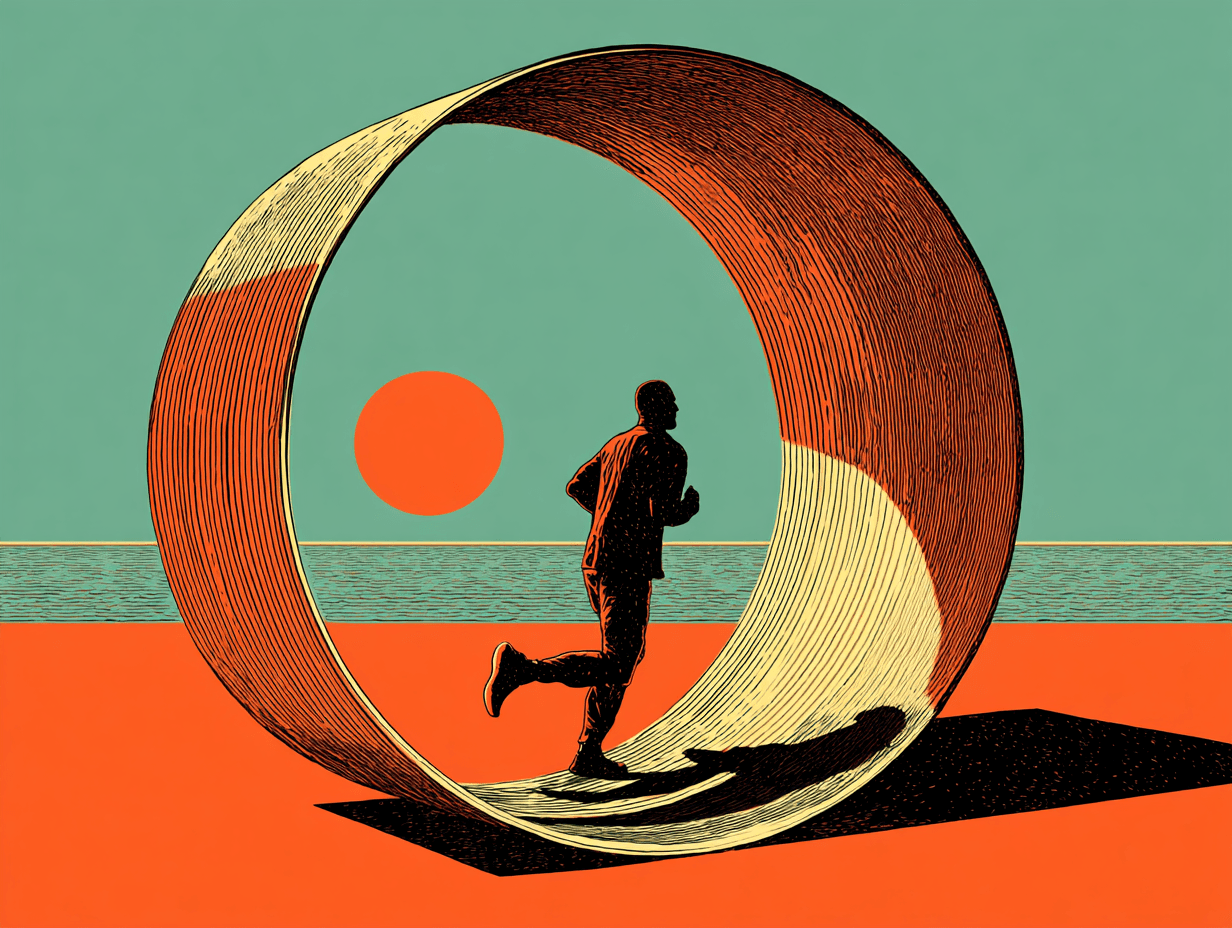
A hunter-gatherer 10,000 years ago measured capital in terms of calories, physical materials, and any other resource that increased the tribe's chances of survival. They lived with constant scarcity. Even if the tribe just killed two woolly mammoths, killing another would increase their likelihood of survival. The genetics of the "lazy" hunter-gatherers that decided to take two weeks off after a big kill are no longer in the gene pool today.
But there were limits. A nomadic lifestyle meant the tribe could only accumulate what they could carry. If the seasons changed or food sources dried up, they had to pack their belongings and move to another location more conducive to survival. A primitive human could not carry 10,000 lbs of animal meat 100 miles to their next home.
Modern supply chains have changed this dynamic. Humans can now settle in one location for an entire lifetime without fear of dwindling resources. This has led to a drastic increase in the ease of life. It has also allowed us to accumulate copious amounts of capital.
Unlike our ancestors, we face no practical limit on accumulation. We can let physical possessions pile up in our homes and store infinite amounts of wealth in a digital database.
Now that most of us are not concerned with survival on a daily basis, the constant pursuit of more exists in other forms: status, influence, power, and wealth. When someone on the lower rungs of the economic ladder looks at the massive amounts of capital attained by Jeff Bezos or Elon Musk, it's easy for them to say, “If I were in their position, I would donate most of my money to charity and buy a quaint home in the mountains.”
But how do you think they got to the position they’re in? The same way hunter-gatherers thousands of years ago made it through hard times—always striving for more. We’re all playing the same game, some people just have higher stakes.
Modern psychology refers to the constant pursuit of more as hedonic adaptation. The general principle is that no matter how high the highs, or how low the lows, one will always soon return to a genetic baseline.
I have spent most of the last three years living out of a backpack.
One of the perks of this lifestyle is that I can pack all of my belongings and be on a bus to a new location within an hour.
One of the downsides of this lifestyle is that I can pack all of my belongings and be on a bus to a new location within an hour.
Despite many data points to draw from, I continuously fall into the trap of thinking that the next destination will lead to a higher permanent state of well-being. If only I go to a place with more beautiful mountains, or overlooking the ocean, or filled with amazing nightlife and events, then I will finally be happy. The more I travel to different destinations around the world, the more I realize my own internal struggles travel with me.
So how does one fight the natural evolutionary pressure of constant desire? One of the most ancient and tested approaches is the buddhist path. Renounce all attachments and eliminate desire from your psychology to avoid suffering. While certainly a viable option, most of us are not willing to dedicate decades of our lives to meditation.
A more modern approach I take looks something like this: I write down every single desire I currently have in my life. I try to be as granular as possible. Instead of “make more money”, I might write “grow my business until it is generating $10,000 a month in revenue.” The desires need to be achievable so they can be definitively crossed off at a point in time. Once I have listed every desire I can think of, I keep only the most important and delete the rest. The fewer the better—1 is optimal.
I will allow myself to suffer in the pursuit of whatever remains on the list, but I try not to allow any other desires to occupy my mind. Once they have been achieved, I check them off and move on to the next most important item. This strategy is far from perfect, but it at least gives me a framework for understanding what drives my suffering.
It will be a lifelong struggle to fight the forces of evolution and accept what I already have. But ultimately, if I want to find peace, I have to determine for myself what is enough, then get off the treadmill and enjoy life for the beauty it already holds.